What Is a Nebula? Emission, Reflection, Dark Nebulae and Supernova Remnants
A nebula is a cloud of gas and dust floating in space. Some are nurseries where stars are born; others are what dying stars leave behind. Here are the 46 nebulae you can find in Planetica's galaxy view, grouped by type.
| What it is | A cloud of gas and dust in space |
|---|---|
| Types | Emission · reflection · dark · planetary · supernova remnant |
| Nearest big star-forming cloud | Orion Nebula (about 4,400 light-years) |
| In Planetica | Galaxy view → tap a nebula name for details |
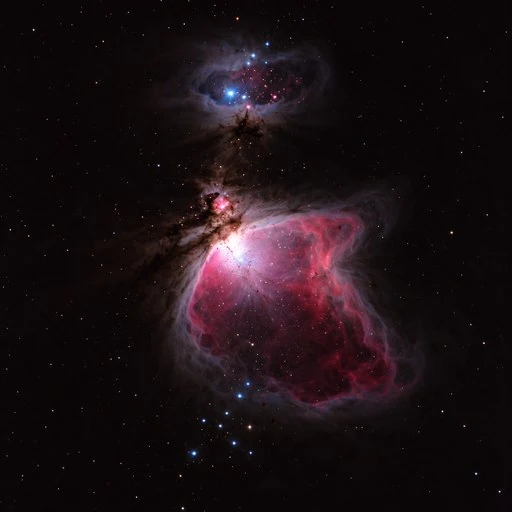
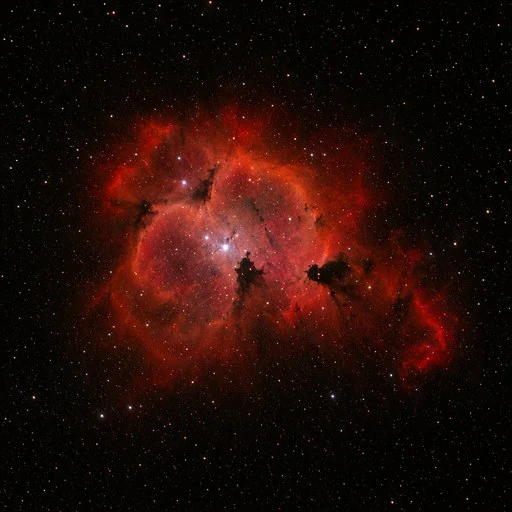
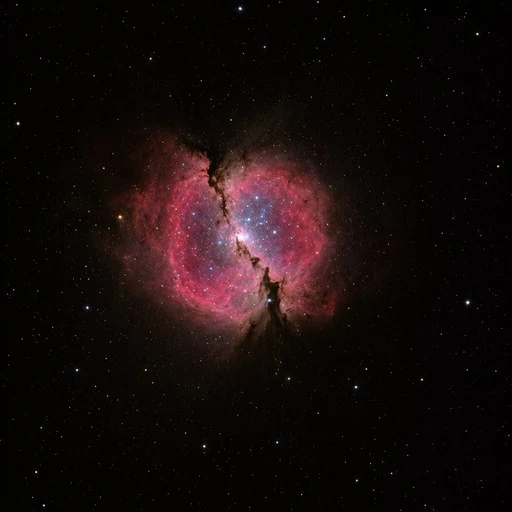
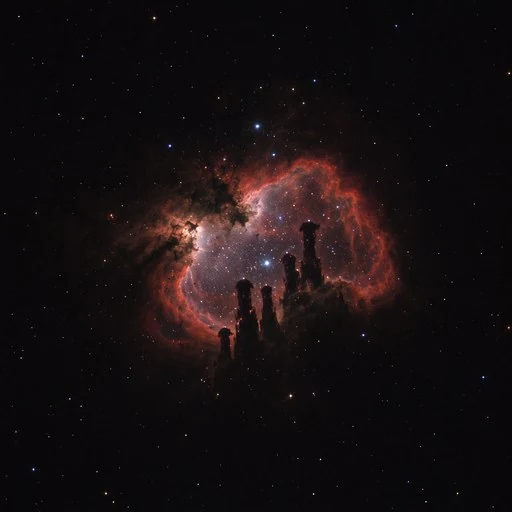
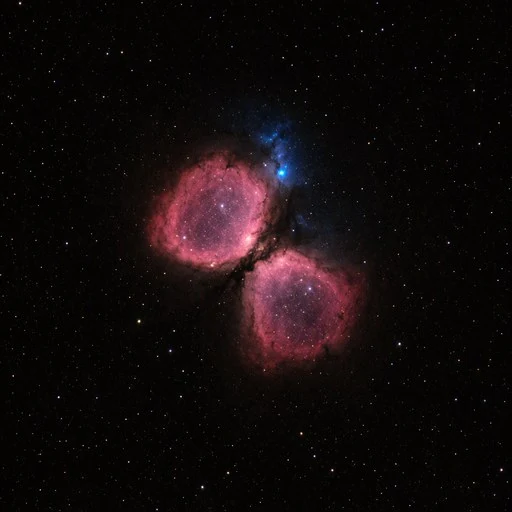
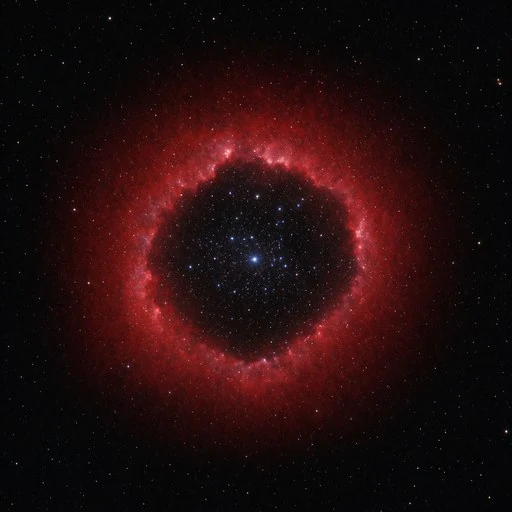
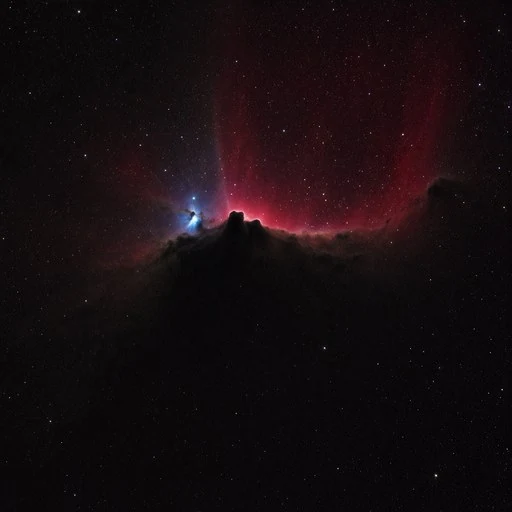
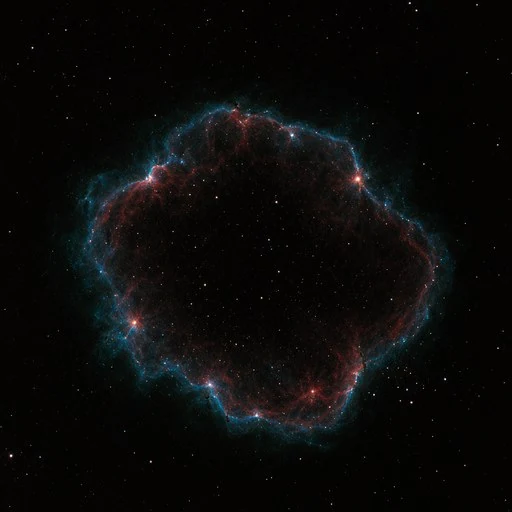
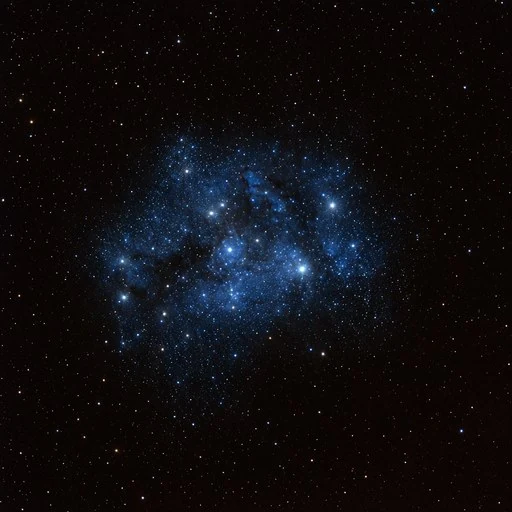
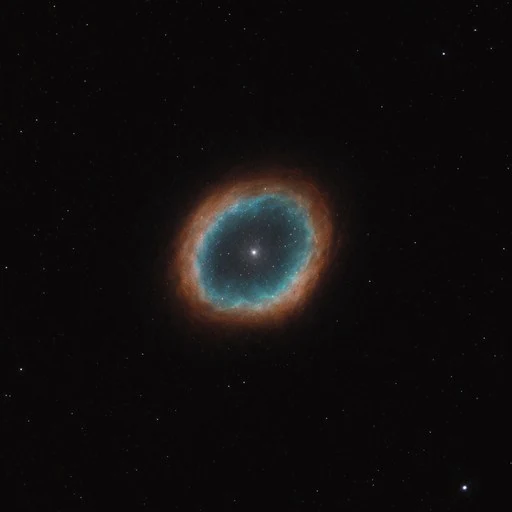
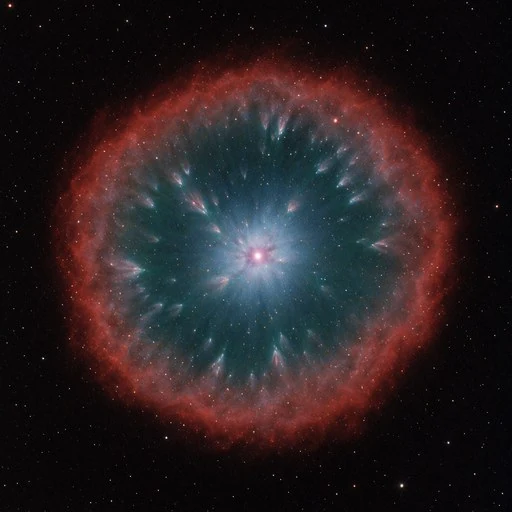
These are not photographs of the real objects; they are rendered by the Planetica planet maker.
What is a nebula?
A nebula is a cloud of gas and dust spread out between the stars. It is mostly hydrogen, and when gravity pulls a clump together, new stars are born. In the other direction, when an old star sheds its outer layers or a massive star explodes, the debris becomes a nebula again. So nebulae are places where stars are born and where they die.
They look soft and hazy, but they are enormous: a single nebula can hold thousands to hundreds of thousands of solar systems. Only a few, like the Orion Nebula, are visible to the naked eye; most need a telescope or a long-exposure photo.
Types of nebulae
- Emission nebulae glow on their own because nearby hot stars ionize the gas. The red color is light from hydrogen.
- Reflection nebulae shine because dust reflects starlight, not because the gas glows. They are usually blue.
- Dark nebulae are dust clouds that block the light behind them and appear as dark silhouettes. The Horsehead Nebula is the classic example.
- Planetary nebulae are the outer layers shed by an aging star. They have nothing to do with planets; the name comes from how round they look in a small telescope.
- Supernova remnants are the gas flung outward after a massive star explodes. The shock wave sweeping up surrounding gas often forms thin filaments.
Emission nebulae: star-forming clouds
- Orion Nebula — One of the brightest star-forming clouds in the sky, visible to the naked eye in the "sword" of Orion. Newborn stars light up the gas. (about 4,400 light-years away · about 91 ly across)
- Carina Nebula — A star-forming cloud far larger and brighter than the Orion Nebula. The very massive star Eta Carinae lies inside it. (about 7,500 light-years away · about 290 ly across)
- Lagoon Nebula — An emission nebula (M8) toward Sagittarius. A dark dust lane across its middle looks like a lagoon, hence the name. (about 4,100 light-years away · about 180 ly across)
- Trifid Nebula — M20 in Sagittarius. Dark dust lanes split a red emission nebula into three parts, with a blue reflection nebula beside it. (about 5,500 light-years away · about 91 ly across)
- Eagle Nebula — M16 in Serpens, famous for the "Pillars of Creation", columns of gas where new stars are forming. (about 5,900 light-years away · about 200 ly across)
- Omega Nebula — M17 in Sagittarius, a bright star-forming cloud shaped like the Greek letter omega, or a swan. (about 6,200 light-years away · about 160 ly across)
- North America Nebula — A large emission nebula (NGC 7000) in Cygnus, shaped like the continent of North America. (about 2,600 light-years away · about 160 ly across)
- Rosette Nebula — A rose-shaped ring in Monoceros. A young star cluster at its center has blown a hole in the gas. (about 5,200 light-years away · about 260 ly across)
- Heart Nebula — A heart-shaped emission nebula (IC 1805) in Cassiopeia, where a cluster of massive stars is forming. (about 6,500 light-years away · about 260 ly across)
- California Nebula — An elongated emission nebula (NGC 1499) in Perseus that resembles the US state of California. (about 3,300 light-years away · about 130 ly across)
- Cat's Paw Nebula — A star-forming cloud (NGC 6334) in Scorpius. Its bright lobes look like a cat's paw print. (about 4,200 light-years away · about 130 ly across)
- NGC 3603 — A star-forming region toward Carina, home to a dense cluster of very massive young stars. (about 23,000 light-years away · about 98 ly across)
- Barnard's Loop — A huge loop of gas wrapped around Orion, thought to be shaped by the region's massive stars. (about 1,400 light-years away · about 390 ly across)
- Gum Nebula — A very large, faint emission nebula (the Gum Nebula) spread over many degrees of sky toward Vela and Puppis. (about 1,500 light-years away · about 1,100 ly across)
- Tarantula Nebula — A giant star-forming region inside the Large Magellanic Cloud, one of the most active in our neighborhood of galaxies. (about 160,000 light-years away · about 720 ly across)
- NGC 346 — The largest star-forming region in the Small Magellanic Cloud, where young hot stars light up the gas. (about 200,000 light-years away · about 460 ly across)
- Sagittarius A (Galactic Center) — The strong radio region at the center of the Milky Way, containing the black hole Sagittarius A*, about four million times the mass of the Sun. (about 27,000 light-years away · about 140 ly across)
- Sagittarius B2 — A giant molecular cloud near the Galactic Center, well known for the many complex organic molecules found in it. (about 26,000 light-years away · about 200 ly across)
- W43 — A huge star-forming region near one end of the Galactic bar, where a great many stars are forming at once. (about 18,000 light-years away · about 290 ly across)
- W51 — A large star-forming region toward Aquila, with both star-forming clouds and a supernova remnant. (about 18,000 light-years away · about 390 ly across)
- W49 — One of the largest star-forming regions in the Milky Way, hosting clusters of very massive stars. (about 36,000 light-years away · about 360 ly across)
- NGC 3576 — An emission nebula toward Carina, with gas stirred up by the winds of young stars. (about 9,100 light-years away · about 140 ly across)
- RCW 49 — An emission nebula toward Carina–Centaurus. The young cluster Westerlund 2 at its heart lights up the gas. (about 14,000 light-years away · about 230 ly across)
- NGC 3324 — An emission nebula next to the Carina Nebula, where a young cluster has carved a cavity in the gas. (about 9,500 light-years away · about 140 ly across)
- G305 — A star-forming region along the Galactic plane, containing young clusters of massive stars. (about 12,000 light-years away · about 260 ly across)
- NGC 6188 — An emission nebula in Ara, where the winds of young massive stars have sculpted the gas. (about 14,000 light-years away · about 180 ly across)
- NGC 2467 — A star-forming region in Puppis with several overlapping nebulae lit by young stars. (about 13,000 light-years away · about 160 ly across)
- NGC 2359 (Thor's Helmet) — An emission nebula in Canis Major. A very hot star at its center blew the gas into a helmet shape. (about 12,000 light-years away · about 120 ly across)
- NGC 1893 (Tadpole Nebula) — A young cluster and emission nebula in Auriga. Nearby gas columns look like tadpoles. (about 12,000 light-years away · about 160 ly across)
- NGC 281 (Pacman Nebula) — An emission nebula in Cassiopeia whose dark dust lanes make it look like Pac-Man. (about 9,100 light-years away · about 120 ly across)
- Bubble Nebula (NGC 7635) — A soap-bubble-shaped nebula in Cassiopeia, blown into the gas by the wind of a very massive star. (about 9,500 light-years away · about 46 ly across)
- NGC 7538 — A large star-forming region in Cepheus, where very massive stars are forming within. (about 8,800 light-years away · about 98 ly across)
Reflection nebulae
- Pleiades Nebula — The blue reflection nebula around the Pleiades cluster in Taurus. Dust reflects the light of young stars. (about 440 light-years away · about 39 ly across)
- Witch Head Nebula — A blue reflection nebula (IC 2118) in Eridanus. Dust reflects the light of the bright star Rigel. (about 880 light-years away · about 120 ly across)
- Rho Ophiuchi Cloud — A colorful star-forming cloud near Antares, with reflection, emission and dark nebulae side by side. (about 460 light-years away · about 39 ly across)
- Iris Nebula — A reflection nebula (NGC 7023) in Cepheus. A young star lights the dust blue, like petals of an iris. (about 1,400 light-years away · about 20 ly across)
- M78 — One of the brightest reflection nebulae in the sky, in Orion. Dust reflects the light of young stars in blue. (about 5,200 light-years away · about 20 ly across)
Supernova remnants
- Vela Supernova Remnant — The remains of a star that exploded about 10,000 years ago, toward Vela. The expanding gas covers a wide patch of sky. (about 950 light-years away · about 390 ly across)
- Crab Nebula — M1 in Taurus, the remnant of a supernova seen in the year 1054, with a rapidly spinning neutron star at its center. (about 6,500 light-years away · about 33 ly across)
- Veil Nebula (Cygnus Loop) — A supernova remnant in Cygnus. The shock wave of a star that exploded tens of thousands of years ago left thin, tangled filaments of gas. (about 2,500 light-years away · about 260 ly across)
- Cassiopeia A (supernova remnant) — A supernova remnant in Cassiopeia. The explosion seems to have happened only a few centuries ago, and it is very bright in radio waves. (about 11,000 light-years away · about 26 ly across)
- Kepler's Supernova Remnant — A supernova remnant in Ophiuchus, the gas cloud left by Kepler's supernova that appeared in 1604. (about 16,000 light-years away · about 20 ly across)
- W44 (supernova remnant) — A supernova remnant in Aquila, the trace of a star that exploded tens of thousands of years ago, with a pulsar at its center. (about 9,800 light-years away · about 100 ly across)
Planetary nebulae
- Ring Nebula — M57 in Lyra, a planetary nebula: the outer layers shed by an aging star, seen as a ring. (about 7,500 light-years away · about 9.1 ly across)
- Helix Nebula — A planetary nebula (NGC 7293) in Aquarius, among the nearest to Earth, so it appears large. (about 680 light-years away · about 12 ly across)
Dark nebulae
- Horsehead Nebula — A dark cloud of dust in Orion, seen as a horse-head silhouette against a brighter nebula behind it. (about 1,400 light-years away · about 23 ly across)
How to explore them in Planetica
In the galaxy view, nebulae appear with name labels, and up close they turn into three-dimensional clouds shaped like the real thing. Tap a label to see its type, distance, size and a short description, and use "Fly closer" to head straight there. If nebulae look too bright or too dim, adjust "Nebula brightness" under More > Display & language; set it to 0 to hide them all.
Distances and sizes are approximate.
Read more
- 9 Types of Planets
- Star Types and Colors: Spectral Classes O, B, A, F, G, K, M
- What Is a Nebula? Emission, Reflection, Dark Nebulae and Supernova Remnants
- What Is the Habitable Zone (Goldilocks Zone)?
- The Sun
- The Moon
- Solar and Lunar Eclipses
- What Causes the Seasons
- The Life of a Star
- The Milky Way and Galaxies
- Black Holes
- Exoplanets
- Zodiac Signs vs Constellations
- Sun, Moon and Rising Signs
- Zodiac Elements and Modalities
- Weight and Gravity on Other Planets
- Planet Years and Your Age
- Astrology and Astronomy Compared
- Meteor shower calendar and how to watch
- What Mercury retrograde really means
- Why isn't Pluto a planet?
- How to find the North Star
- How far is a light-year?
Sources
Written by the Planetica editor, based on the sources below.
Last updated:
Create your own planetary system
Enter a name and a birthday to get a one-of-a-kind planetary system, placed next to a real star in your birthday constellation.